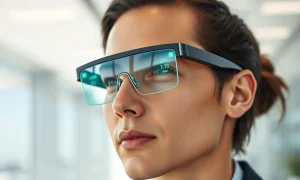
Viture announced Vonder on Tuesday, its first pair of smart glasses with no virtual display and no embedded camera, priced at $299. The San Francisco-based company, known for plug-in display glasses such as the Viture One and the Viture Beast, said preorders open September 28 and the frames ship in November, Wired reported.
Viture cofounder and CEO David Jiang described the device as a pivot away from face computers that connect by USB-C to project a screen, a category the company built for gamers and big-screen entertainment but which he acknowledged fell short on comfort and fashion because of its chunky design. Vonder borrows its name from “wonder,” with a V.
Also read: Google Launches Five Googlebook Laptops From $899
Key facts
- Vonder costs $299, can be fitted with prescription lenses, and comes in multiple frame shapes and colors with clear, transition or shaded sunglass lenses.
- The frames carry microphones and speakers for music, dictated map directions and phone calls, plus a blue indicator light on the arms that turns on when audio recording is active.
- A built-in assistant draws on OpenAI’s ChatGPT, Anthropic’s Claude, Google’s Gemini and DeepSeek, choosing whichever model is quickest and most economical for the task.
- Viture claims about 16 hours of battery life, and says passive bone-conduction sensors let the glasses pick up the wearer’s speech through the day without recording the wider environment.
- Preorders launch September 28, 2026, with shipping in November.
A memory graph built from one side of the conversation
The glasses assemble what Viture calls a personal memory graph: places visited, sports played and topics the wearer confides, displayed in the app as a web of connections. A meeting mode can record the surrounding environment on board, but otherwise Viture says the bone-conduction sensors mainly capture the wearer’s own audio vibrations.
Jiang, who has worn the glasses for three months, said he has asked them to surface coffee shops matching his preferences and to help him work out why he has felt stressed. During a demo he said the assistant also raised topics he had been mulling, including hiring decisions, a plan for announcing the glasses a day before Meta Connect, and a dossier on the visiting reporter that it presented the morning of the visit.
Also read: US Chip Industry Faces Shortage of Up to 157,000 Workers by 2030, Report Warns
He framed the design as a deliberate imitation of human recall. According to Jiang, the system is not a transcript or a summary but an attempt to organize memory the way the brain does, and he argued it can exceed a person’s own recall.
The privacy pitch, and the missing perspective
Viture joins brands such as Xreal and Even Realities in distancing itself from Meta’s Ray-Ban glasses, whose camera features have drawn criticism. Viture’s answer is to omit cameras entirely and to keep the recording indicator less central and less immediately noticeable than the light on the Ray-Ban Meta frames.
The trade-off is perspective. Because the glasses only capture the wearer’s side, users who want a thought stored need to be comfortable speaking it aloud. Asked how the memory graph accounts for anyone else’s view, Jiang said he tends to repeat what another person said, which he described as a consequence of turn-by-turn conversation, and he estimated the missing portion at roughly 10% to 15% rather than half.
Pressed on whether hearing only his own voice would bias him when revisiting an argument, Jiang recounted how the glasses told him he had been wrong about shouting criticism at his 10-year-old son during tennis tournaments. He said the unprompted message changed his behavior, improved his relationship with his child, and left him feeling his life had improved over three months of use.
Vonder’s reception will depend on whether buyers accept a wearable that listens to them almost continuously in exchange for a private, camera-free memory assistant, and whether Viture can deliver the November shipments it has promised.
Why it matters
As AI assistants move from phones into eyewear, the split between camera-first and audio-first designs is becoming the industry’s main privacy dividing line. Viture is betting that dropping the camera removes the social friction that has dogged rival frames, while a memory graph gives the device a reason to be worn daily rather than occasionally. That also shifts the burden onto the wearer, since a record built from one person’s speech is inherently one-sided. For shoppers who already own display glasses, Vonder is a different product rather than an upgrade: no screen, no cable, no camera.
What to watch
The September 28 preorder date and the November shipping window are the near-term tests of whether Viture can move Vonder from demo to delivery. How reviewers and buyers judge the memory graph’s accuracy, and whether the multi-model routing works as described, will shape the launch.

Source: Wired