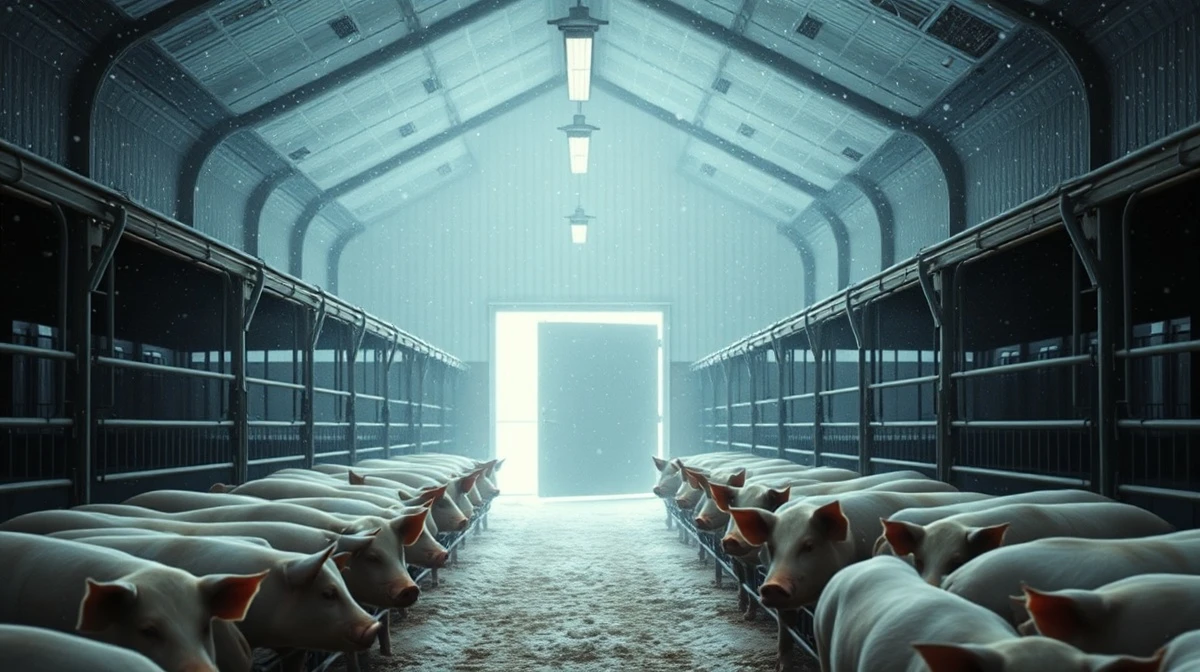
Lean hog futures closed lower on Wednesday, March 20, 2025, with contracts falling between 85 cents and $2.02 across the board. The decline came as winter weather, including a blizzard affecting parts of Iowa, disrupted slaughter operations and pressured market sentiment.
Price Action and Key Levels
The most-active April 2025 contract settled at $85.575 per hundredweight (cwt), down $2.025 on the day. The May 2025 contract closed at $88.700, losing $1.500, while the June 2025 contract ended at $96.500, a decline of 85 cents. The moves reflect a broad pullback in the livestock complex, with traders weighing supply disruptions against softer demand signals.
Also read: SpaceX, OpenAI, and Anthropic: The AI IPO Wave That Could Reshape Public Markets
Fundamentals: Cash Markets and Pork Cutout
Despite the futures weakness, cash hog prices showed strength. The USDA national average base hog negotiated price was reported at $91.02 on Wednesday afternoon, up $2.74 from the previous day. The CME Lean Hog Index, a key cash benchmark, rose 4 cents to $89.32 as of March 17.
However, the pork cutout value—a measure of wholesale pork prices—declined. The Wednesday afternoon FOB plant pork cutout from the USDA was reported at $95.19 per cwt, down 45 cents. The loin, butt, and rib primals were all reported lower, signaling potential softening in wholesale demand.
Also read: SpaceX IPO Allocation Leaves Binance, Kraken Users Empty-Handed Despite Massive Demand
Weather Disruptions and Slaughter Data
The winter storm moving through the Midwest, particularly in Iowa—the nation’s largest hog-producing state—slowed slaughter operations. USDA estimated Wednesday’s federally inspected hog slaughter at 377,000 head, bringing the week-to-date total to 1.352 million head. That figure is down 113,000 head from the same period last week and 108,158 head below the same week last year.
These disruptions can create short-term supply bottlenecks, as hogs ready for market may be delayed, potentially pushing more supply into subsequent weeks and weighing on prices.
Market Implications for Producers and Traders
For hog producers, the combination of lower futures prices and weaker cutout values suggests narrowing margins in the near term, even as cash prices remain elevated. For traders, the market is handling a complex environment of weather-related supply shocks, shifting demand patterns, and broader macroeconomic uncertainty.
The week-to-date slaughter deficit compared to last year is notable and may provide some underlying support if packers need to increase throughput in the coming weeks to meet demand. However, the risk of further weather disruptions remains.
Conclusion
Wednesday’s session highlighted the sensitivity of the lean hog market to operational disruptions and shifting wholesale demand. While cash prices remain firm, the futures market is pricing in near-term uncertainty. Traders will be watching Thursday’s slaughter data and the USDA’s weekly export sales report for further clues on demand.
FAQs
Q1: What caused lean hog futures to fall on Wednesday?
A1: Futures declined due to a combination of winter weather disrupting slaughter operations in Iowa and a lower pork cutout value, which signals weaker wholesale demand.
Q2: How did cash hog prices perform compared to futures?
A2: Cash hog prices rose, with the USDA national average base price increasing by $2.74 to $91.02. This divergence between cash and futures is not uncommon during weather disruptions.
Q3: What is the CME Lean Hog Index?
A3: The CME Lean Hog Index is a two-day weighted average of cash hog prices, used as the settlement benchmark for CME lean hog futures. It provides a key reference for the physical market.