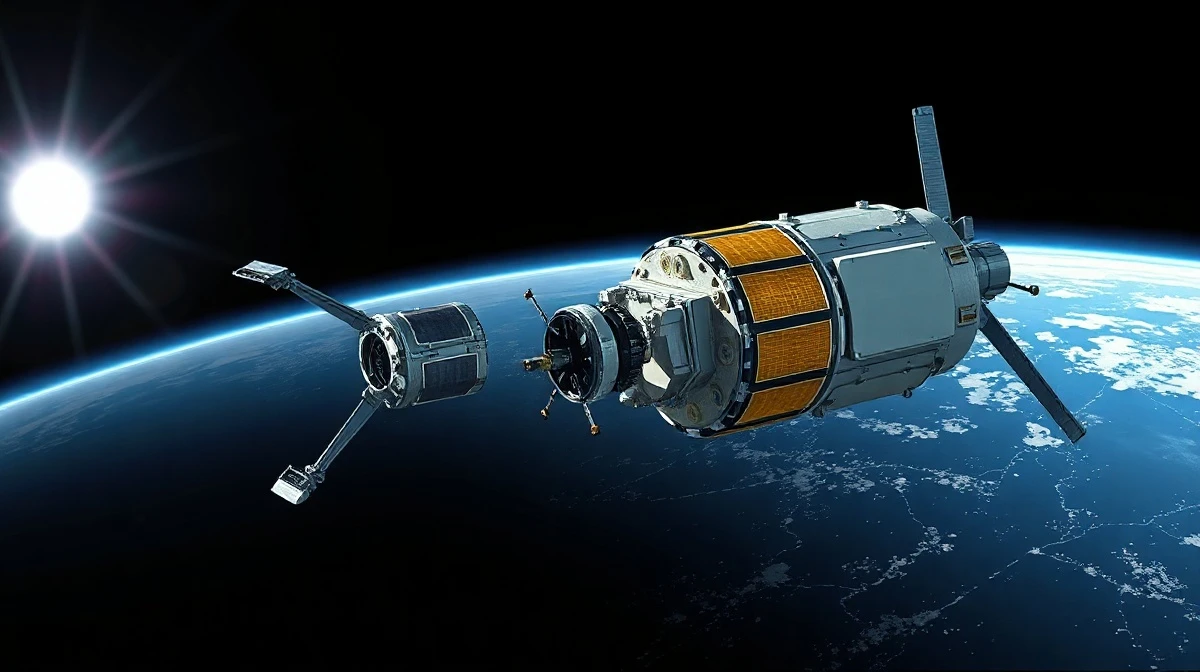
Northrop Grumman’s Mission Extension Vehicle-1 (MEV-1) has unplugged from an Optus communications satellite this week after more than a year of service, freeing the spacecraft to move on to its next assignment and making room for a new generation of robotic servicers. The undocking marks the end of a mission that kept the Australian firm’s satellite in its correct orbital position, extending its operational life.
The MEV-1’s departure sets the stage for a more ambitious follow-up. In July, a SpaceX Falcon 9 rocket launched four new Northrop spacecraft into orbit. The centerpiece is the Mission Robotic Vehicle (MRV), a satellite equipped with two advanced robotic arms developed by DARPA, the U.S. military research agency. The other three are Mission Extension Pods (MEPs) — smaller, simpler modular propulsion units that can be attached to a satellite to keep it flying.
Also read: Block Blast!, 2025’s most-downloaded mobile game, goes ad-free on Apple Arcade this September
These four spacecraft are now heading toward targets roughly 27,000 miles above Earth, where in 2027 the MRV will use its robotic arms to attach an MEP to the Optus satellite. If successful, the operation will mark a significant evolution in how satellites are maintained, moving from simple docking to more complex, hands-on servicing.
Why satellites need a mechanic
The need for such services stems from a fundamental limitation of satellite design. Communications and Earth-observation satellites typically end their missions not because their computers or transceivers fail, but because they exhaust the fuel needed to stay in their designated orbital slot. The Optus satellite, launched in 2009, was designed for a 15-year lifespan. With the help of the MEV, it could continue operating and generating revenue for another six years.
Also read: India’s Yulu Raises $93M to Expand E-Bike Fleet as Quick-Commerce Demand Surges
Northrop’s approach to this problem has been evolving. Two MEVs are currently in orbit, launched in 2019 and 2020. Together, they have provided a combined 10 years of life extension to three customers, including two Intelsat spacecraft and the Optus satellite. MEV-1 will now wait in a parking orbit for its next customer, while MEV-2 remains attached to an Intelsat satellite until 2030.
The new MRV and MEP system represents a shift in the business model. Instead of Northrop owning and operating the life-extension hardware, satellite operators will buy and own the MEPs, which are permanently attached to their spacecraft. This frees the MRV to service more vehicles, creating a cheaper, more scalable offering.
The technical challenge of in-orbit docking
Executing these maneuvers is a serious engineering feat. The vehicles must autonomously approach one another and dock safely, a complex task when both are moving at velocities of thousands of miles per hour. The MEVs use a docking probe to plug into satellite thruster nozzles. The MRV, however, faces a more delicate challenge: carefully attaching the MEPs using its robotic arms without damaging the target satellite.
Unlike most satellites, the MRV is designed to be refueled in orbit — a proof of concept for the kind of capabilities other satellites will need if in-orbit servicing becomes standard practice. Currently, the added cost and weight of such adaptations keep many spacecraft operators from investing in them.
Cassie Wong, Northrop’s director of logistics and servicing, frames the goal as “a pattern shift where we can see space as sustainable, with a more resilient architecture and infrastructure base where we can do things like spacecraft repairs, life extension, or even upgrades and maintenance of satellites.”
Market forces and the road ahead
The timing of this shift is driven by falling launch costs and cheaper space components, which are making repair missions economically viable. However, the industry is also moving in two directions at once. On one hand, companies like Starlink and Amazon’s LEO project are deploying large constellations of cheap, replaceable satellites in low Earth orbit, where life extension makes little sense. On the other, there remains a large fleet of expensive, high-value satellites in geostationary orbit that could benefit significantly from extended service.
Wong hopes the MRV will eventually take on other missions, such as adding new components to satellites or adjusting their orbits. Defense customers are a likely target, given the number of expensive military satellites in high orbits and DARPA’s role in developing the MRV’s arms. The U.S. Space Force has previously characterized a Chinese servicing spacecraft with robotic arms as a weapon, since it could theoretically grapple and degrade a rival satellite. Northrop maintains that its vehicles are focused on servicing missions.
The company also sees potential for the MRV to operate in low Earth orbit, extending the life of valuable assets there. Meanwhile, the startup Katalyst Space is attempting a similar mission to extend the life of a NASA space telescope after malfunctions left the vehicle tumbling last month. The company says it has a fix in place and hopes to complete the mission.
As the first MEV moves on to its next customer, the success of the upcoming MRV mission in 2027 will be a key test of whether robotic servicing can become a routine part of space operations, rather than a one-off engineering marvel.