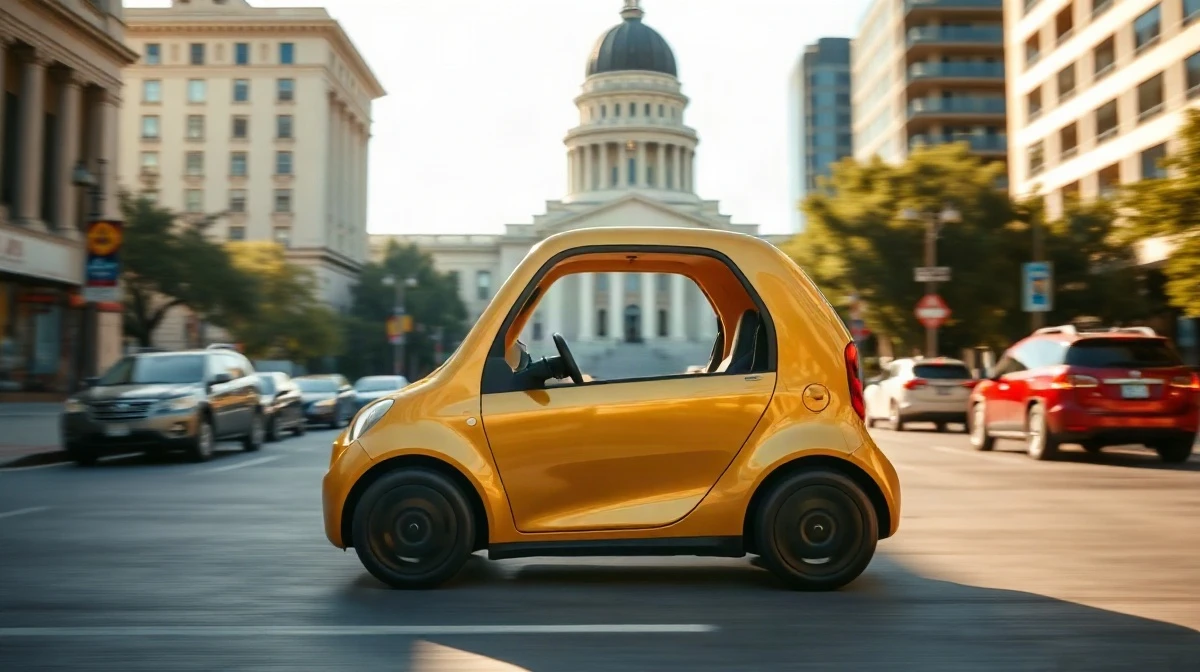
Tesla on Thursday launched its long-awaited Cybercab robotaxi service in Austin, Texas, deploying a fleet of small, gold, two-seater vehicles with no steering wheel or pedals. The event marks a critical inflection point for the company, which has staked its future on proving it can move beyond selling cars to operating a fully autonomous ride-hailing network.
The company has not disclosed the exact size of the initial fleet, but Texas state records show 420 autonomous vehicles registered in the state, and Tesla staged Cybercabs in Austin and other U.S. cities in the days leading up to the launch. CEO Elon Musk has promoted the event with dramatic posts on X, including an AI-generated image of a “Storm of Cybercabs,” signaling a shift from the company’s earlier cautious messaging about safety.
“The streets won’t be the same anymore,” Ashok Elluswamy, Tesla’s head of AI, wrote on X ahead of the launch.
A decade of promises converge on a two-seater
Musk first revealed the Cybercab in October 2024 at a Hollywood studio lot, but the concept dates back more than a decade. In 2016, Musk claimed every Tesla built had the hardware necessary for full autonomy, needing only a software update. That prediction proved wrong — Tesla has since revised its hardware multiple times, and Musk admitted in recent years that millions of older vehicles would require retrofits.
Also read: X Moves All US Creator Payouts to X Money, Dropping Stripe for Instant Payments
The Cybercab emerged from Tesla’s effort to develop a next-generation, lower-cost EV platform. Musk, intent on achieving full autonomy, decided against building a manually drivable car on that platform, focusing instead on a purpose-built robotaxi. In April 2024, he approved sweeping layoffs, writing that Tesla would go “balls to the wall for autonomy,” calling other efforts “variations on a horse carriage.”
Tesla has been testing its robotaxi software since June 2025 using modified Model Y SUVs in Austin, initially with safety drivers and later with teleoperators. The company has reported several dozen minor incidents, mostly low-speed collisions with stationary objects. In July 2025, Tesla disclosed that paid miles on its robotaxi network had declined, though executives have argued the Cybercab’s lower cost structure will enable faster scaling and profitability.
What the Cybercab launch means for Tesla and the robotaxi race
The Cybercab’s design prioritizes cost: it is smaller, lighter, and uses a lower-capacity battery than any other Tesla, reducing raw material expenses. Tesla’s supporters argue this gives it a decisive economic edge over Waymo, which operates roughly 4,000 robotaxis and spends far more per vehicle. Musk has echoed that sentiment, replying to a comparison chart with “this doesn’t even take into account the operational efficiency of Cybercab.”
But significant challenges remain. Tesla’s robotaxis have so far operated within geofenced areas in each city, a limitation Musk himself once criticized, saying “if you need a geofenced area, you don’t have real self-driving.” The company’s software also encounters fewer edge cases than Waymo’s, given its smaller fleet, and its previous Model Y robotaxis blended into traffic. The shiny gold Cybercabs will be far more visible — and any failures will be harder to miss.
The launch also carries regulatory and public-perception risks. Tesla has not disclosed how it will handle remote assistance, rider safety, or emergency situations at scale. The company’s approach to safety has drawn scrutiny from federal and state regulators, and the National Highway Traffic Safety Administration has previously investigated Tesla’s driver-assist systems.
For Tesla, the Cybercab is not just another product launch. It is the culmination of Musk’s repeated “fork in the road” framing — the moment the company either transforms urban transportation or reveals that, despite years of effort, it remains fundamentally an automaker. The next several months will show whether Tesla can expand beyond Austin’s geofence, handle the complexity of real-world traffic, and convince riders and regulators that its vision of autonomy is safe and reliable.
This article is for informational purposes only and does not constitute financial advice. The autonomous vehicle market is volatile and subject to regulatory changes; readers should conduct their own research before making investment decisions.