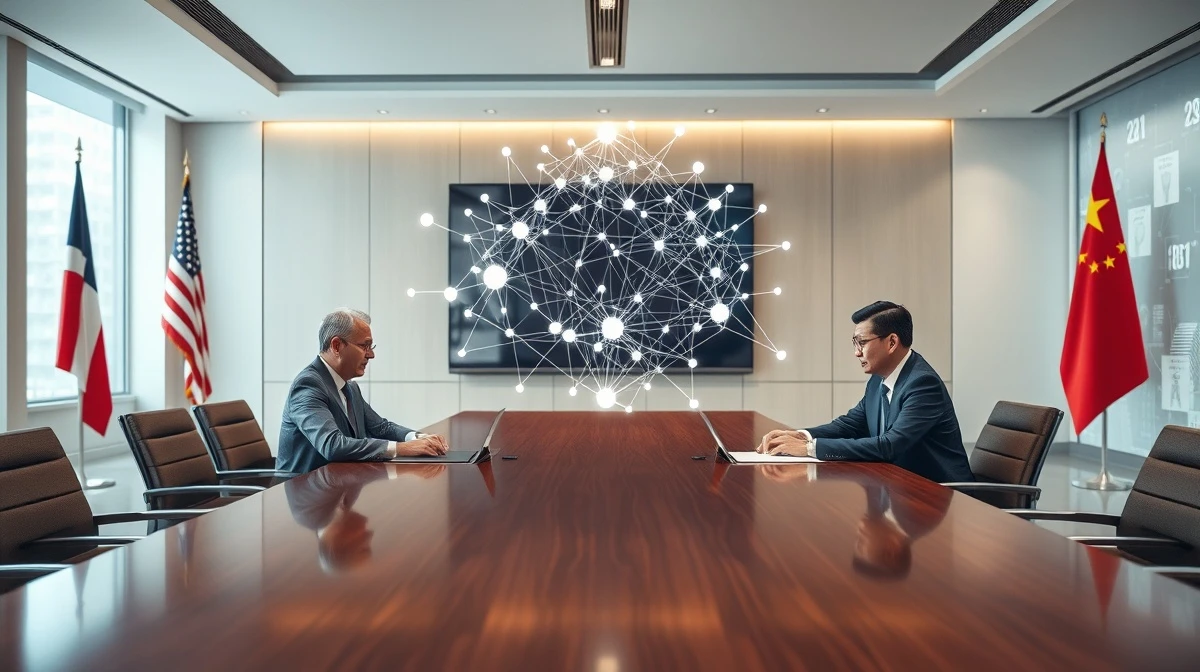
A former senior White House official who served as the administration’s point person on artificial intelligence policy has suggested that the United States and China, despite their deepening technological rivalry, may be able to identify areas of mutual interest in AI governance and safety. The remarks come at a time when global attention is focused on the risks posed by rapidly advancing AI systems and the lack of coordinated international oversight.
Common Ground in a Divided Field
The former official, often referred to as the White House ‘AI czar’ during their tenure, indicated that while competition between the two superpowers is unlikely to ease, there is a pragmatic basis for dialogue. Key areas of potential alignment include establishing shared safety standards for frontier AI models, preventing catastrophic failures, and ensuring that AI systems do not pose uncontrollable risks to either nation. The official emphasized that technical cooperation on safety research does not require either country to compromise its strategic interests or proprietary advantages.
Also read: Crude Oil Bounces on Hormuz Scare, Rally Fails to Convince
Context of Intensifying Rivalry
The suggestion arrives against a backdrop of escalating US-China tensions in the technology sector. Both nations have imposed export controls on advanced semiconductors and AI-related hardware, and each has invested heavily in domestic AI development. The US government has expressed concerns about China’s use of AI for surveillance and military applications, while Beijing has criticized Washington’s restrictions as protectionist. Despite these frictions, experts have long warned that the absence of international norms for AI safety could lead to a race where safety precautions are deprioritized.
Why This Matters for Global AI Governance
The former official’s perspective carries weight because it comes from someone with direct experience in shaping US AI policy at the highest level. It suggests that within policy circles, there is recognition that unilateral approaches to AI safety may be insufficient. If the US and China can agree on baseline safety protocols, it could create a framework that other nations follow, potentially reducing the risk of AI-related accidents or unintended escalation. For businesses and researchers operating in this space, clearer international guidelines could reduce regulatory uncertainty and encourage responsible innovation.
Also read: Peter Thiel-backed fund invests in German drone startup Stark despite past criticism
Challenges Ahead
Any meaningful cooperation faces significant obstacles. Trust between the two governments is low, and each side suspects the other of using safety discussions as a cover for intelligence gathering or industrial espionage. Furthermore, the definition of ‘safe AI’ differs across political and cultural contexts. The former official acknowledged these hurdles but argued that the shared risk of uncontrolled AI development is a powerful motivator for at least exploratory talks.
Conclusion
The suggestion from a former top US AI policy official that common ground with China is possible represents a notable departure from the prevailing narrative of zero-sum competition. While major breakthroughs in cooperation are not imminent, the acknowledgment that dialogue on safety is both necessary and feasible could open a narrow but important channel for future discussions. The global AI community will be watching closely for any signs of formal engagement between the two nations on this front.
FAQs
Q1: Who is the ‘AI czar’ mentioned in the article?
The term refers to a senior White House official who previously led the administration’s AI policy coordination efforts. The specific individual was not named in the source content, but the title has been used for officials such as the Deputy Chief Technology Officer for AI or the Director of the National AI Initiative Office.
Q2: What specific areas of AI could the US and China cooperate on?
Potential areas include establishing shared safety benchmarks for advanced AI models, developing protocols for reporting and mitigating AI-related incidents, and coordinating research on AI alignment and control. These are technical areas that do not directly involve military or commercial applications.
Q3: Has there been any official US-China dialogue on AI safety before?
There have been informal discussions at academic and track-two diplomatic levels, but no formal government-to-government agreements on AI safety currently exist. The Biden administration has expressed openness to dialogue, but concrete talks have been limited by broader geopolitical tensions.